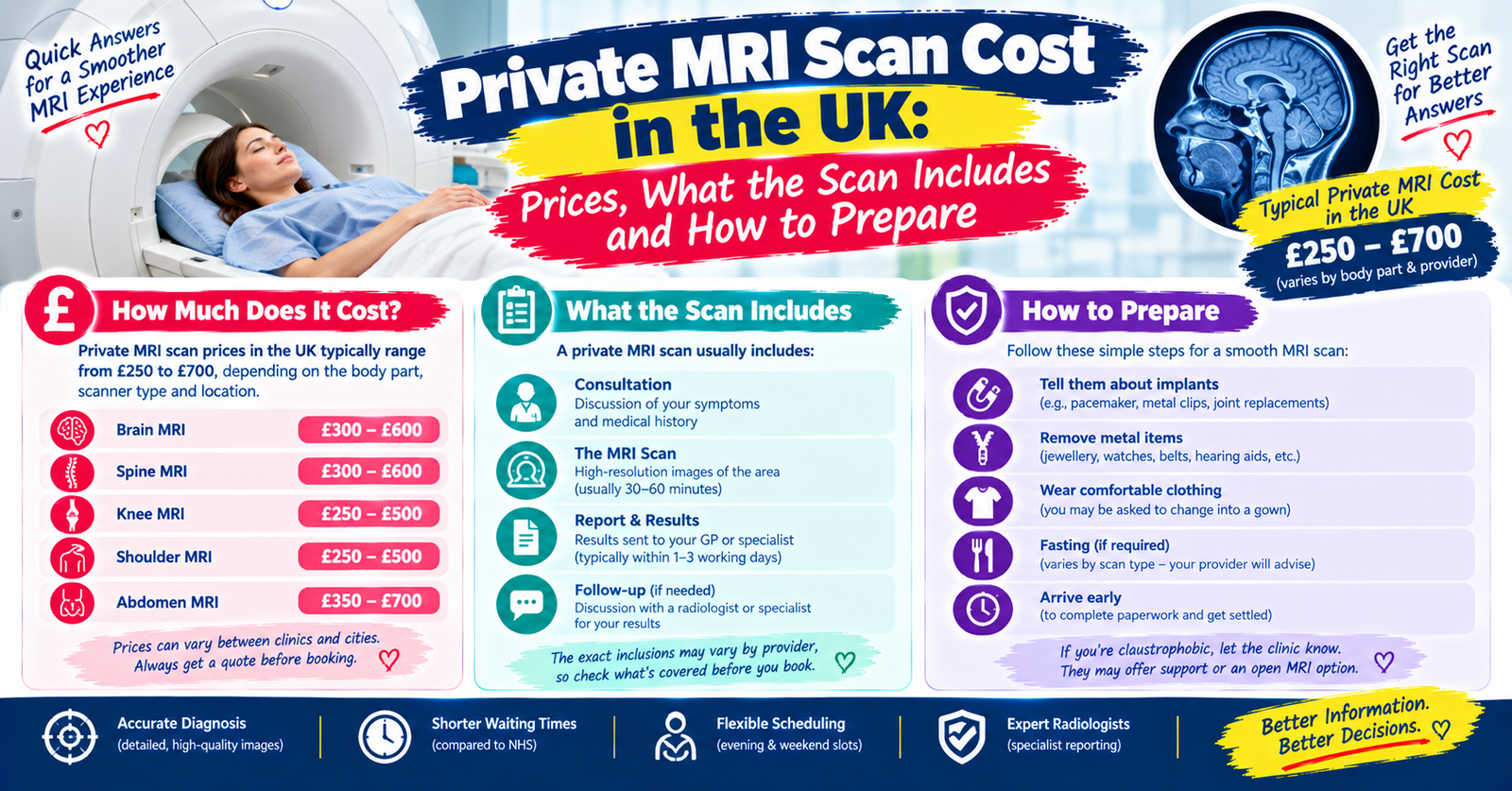
Private MRI Scan Cost in the UK: Prices, What the Scan Includes and How to Prepare
When your knee keeps giving way, your back pain won’t settle or a headache refuses to go, an MRI scan can feel like the missing piece. The NHS can arrange one if your doctor thinks it’s needed, but waiting lists can be long. That’s why more people in the UK are looking at paying for a scan privately, and why the first question is nearly always the same: what will it actually cost?
The short answer is that it depends, and the range is wide. Published 2026 prices from UK providers run from around £199 to £2,500, depending on the part of the body, the clinic, the region and whether you’re booking a single scan or a full-body package. This guide breaks down what drives that range, what your fee should include, and how to get the most from your appointment.
How Much Does a Private MRI Scan Cost in the UK?
For a standard scan of one area, most UK providers currently charge somewhere between about £250 and £750. One recent provider comparison puts a single-area scan at £249 to £750 depending on body part, location and clinic, while another gives a typical range of £299 to £500 for one region such as a knee, shoulder or lower spine.
Here is a general guide to what you might expect to pay for self-funded scans, drawn from several 2026 provider price guides:
| Scan | Typical price range |
| Single joint (knee, shoulder, wrist, ankle) | £250 – £500 |
| Lumbar, cervical or thoracic spine (one section) | £320 – £700 |
| Brain / head | £350 – £750 |
| Whole spine (multiple sections) | £400 – £1,500 |
| Full-body MRI | £600 – £2,500 |
Treat these as ballpark figures rather than quotes. Individual clinics sit above or below them, so always confirm the final price before you book.
What Affects the Price of a Private MRI?
The body part being scanned. Areas that need longer scanning times or more detailed sequences, such as the brain or multiple spinal sections, usually cost more than a single joint.
Where you live. Prices in central London tend to run higher than in many regional clinics, although competition means that some London providers also advertise low entry prices. Regional centres in Scotland, the Midlands and the North often come in lower, though not always.
Type of provider. Large hospital groups often charge more than independent imaging centres or self-referral providers, partly because of the level of consultant involvement and facilities.
Peak versus off-peak timing. Some providers publish lower prices for off-peak slots and higher ones for standard or fast-track appointments. One national price list, for example, ranges from £249 off-peak to £380 for fast-track for a single body part.
Number of areas scanned. Many clinics offer tiered pricing, so a second or third area in the same visit costs less than booking separate scans. A London provider’s guide, for instance, shows lower per-area rates as you add areas.
Contrast dye. If your scan needs a contrast agent, expect an additional charge. Published add-on figures vary, from around £125 to £300 depending on the provider.
The radiologist’s report. This is the one that catches people out. In some cases, a low advertised price covers only the scan, and the consultant radiologist’s report is an additional fee, sometimes £100 to £200 or more. Many providers include the report in the headline price, so check this before booking.
What Does a Private MRI Scan Include?
A good price should cover the following, but it’s worth confirming each point:
- The scan itself, carried out by a trained radiographer
- A written report from a consultant radiologist (the specialist who interprets the images)
- Your images, usually provided digitally and sometimes on a disc
- Access to results, typically within a few working days, although timescales vary by provider
Items that may cost extra include contrast injections, extra body areas, urgent or same-day reporting, a copy of images on disc or a follow-up consultation with a specialist doctor to explain the findings and discuss next steps.
Do You Need a Referral?
It depends on the provider. Many UK clinics now accept self-referral, which means you can book and pay without a GP letter. That’s convenient and often quicker. The trade-off is that without clinical context from a referring doctor, the radiologist is working with limited information, which can reduce how relevant the report is to your symptoms. Whichever route you choose, remember that a scan is only useful if someone qualified interprets it in the context of your symptoms, so plan how you’ll get the results reviewed, whether through your GP, a private consultant or a clinic’s own doctors.
Private MRI vs NHS MRI
On the NHS, an MRI is free at the point of use when your doctor decides you need one. The catch is waiting time. Typical routine waits quoted by providers range from roughly 6 to 20 weeks depending on the type of scan and the area, though urgent cases, such as suspected cancer or serious neurological problems, are prioritised and seen much faster.
Going private makes sense for some people when:
- You’ve been waiting for weeks with ongoing pain or uncertainty
- You need results quickly for work, sport or planning treatment
- You’ve been referred privately and want imaging as part of that pathway
- You have private medical insurance that covers diagnostics
Going private is not always the right route. If you have red-flag symptoms, such as sudden severe headache, new weakness, numbness in the legs with loss of bladder or bowel control, or symptoms that could suggest cancer, contact your GP, NHS 111 or emergency services rather than waiting for a private booking. An MRI is a tool, not a replacement for being assessed by a clinician.
Can Private Medical Insurance Pay for an MRI?
Often, yes. Most private medical insurance policies cover diagnostic scans when they’re recommended by a GP or consultant and relate to a condition that is covered, subject to your policy terms and excess. Some insurers will not pay for self-referred scans, so contact your insurer for pre-authorisation before you book. If you’re paying yourself, it’s worth asking whether any payment plan is available, as some providers offer interest-free instalments.
How to Prepare for a Private MRI Scan
MRI doesn’t use radiation. It uses a strong magnetic field and radio waves to create detailed images of soft tissues, joints, the brain, spine and organs. That magnet is why safety screening is taken so seriously.
Before you go:
- Complete the safety questionnaire honestly. You’ll be asked about pacemakers, implanted devices, metal fragments, surgical clips, cochlear implants, aneurysm clips, joint replacements, tattoos, piercings and any previous operations. Some implants are MRI-safe and some aren’t, so give your clinic as much detail as possible. If you have an implant card, bring it.
- Tell the clinic if you’re pregnant or think you might be. MRI is generally avoided in early pregnancy unless clearly necessary, and contrast agents are normally avoided.
- Mention kidney problems and allergies if you’re having a contrast scan.
- Say if you’re claustrophobic. Many clinics offer open or wide-bore scanners, music, mirrors or a calm explanation to help. Ask in advance, as some scanners are more comfortable than others.
- Plan to remove metal. Leave jewellery, watches, hearing aids, hairpins, belts and anything with metal at home or in a locker. You may be asked to change into a gown.
- Check eating and drinking instructions. Most scans of the spine or joints don’t require fasting, but some abdominal or pelvic scans do. Follow the clinic’s directions.
- Wear comfortable clothes without metal zips, buttons or underwires, and avoid cosmetics that contain metallic particles if you’re having a head scan.
- Take any prescribed medication as normal unless told otherwise.
On the day:
- Expect the scan to take roughly 15 to 60 minutes depending on the area and number of images needed.
- The scanner is loud, with banging and buzzing sounds. You’ll normally be given earplugs or headphones.
- You’ll need to lie very still, because movement blurs the images. Tell the radiographer if you’re uncomfortable and they can help.
- You’ll usually have a way to communicate, such as a call button, and the radiographer can see and hear you throughout.
- Afterwards, you can usually go straight back to normal activities unless you’ve had sedation, in which case you shouldn’t drive.
What About Full-Body MRI Scans?
Full-body MRI scans are being heavily marketed as a health-screening tool, with prices often between £600 and £2,500. It’s worth being cautious here. The NHS doesn’t offer routine full-body MRI screening for people without symptoms, and the scans can sometimes find unrelated, harmless abnormalities that lead to further tests, cost and worry. If you’re thinking about one, talk to your GP or a specialist first about what it can and can’t tell you.
How to Save Money on a Private MRI
- Compare several providers and check what’s included in each quote, especially the radiologist’s report
- Ask about off-peak appointments, which are sometimes cheaper
- Book multiple areas together if you need more than one, since many clinics discount additional areas
- Check for packages or bundled consultations
- Ask your insurer first before paying out of pocket
- Be wary of prices that look too good to be true, and check for hidden fees such as reporting, image copies or booking charges
- Choose a CQC-registered provider. In England, private imaging services should be registered with the Care Quality Commission (with equivalents in Scotland, Wales and Northern Ireland), which gives you some assurance on safety and standards.
Questions to Ask Before You Book
- Is the consultant radiologist’s report included in the price?
- Do I need a referral, and will anyone review the results with me?
- How soon will I get my report?
- Could I need contrast, and what would that cost?
- What type of scanner do you use, and is an open or wide-bore option available?
- Is the clinic CQC-registered (or regulated in my part of the UK)?
- What happens if the scan finds something that needs follow-up?
Key Takeaways
A private MRI scan in the UK typically costs anywhere from about £250 for a straightforward joint scan to well over £1,000 for multi-area or full-body imaging, and prices vary by body part, clinic, location and what’s bundled in. The cheapest advertised fee isn’t always the best value, so check that the radiologist’s report is included and plan how you’ll get your results explained. And if your symptoms are urgent, don’t wait on a booking: speak to a doctor first.
Disclaimer: Prices are indicative, based on publicly listed 2026 provider information, and may change. Always confirm current prices and what’s included with your chosen provider. This article is general information and not medical advice.
Sources to link when publishing: NHS (MRI scan information); Care Quality Commission (CQC); the Royal College of Radiologists patient information; individual provider price pages you reference.